
French Toast Recipe (Custardy Inside, Golden Crust, 15 Minutes Flat)
⭐⭐⭐⭐⭐

A proper french toast recipe gives you a crisp, buttery crust on the outside and a thick, custardy center that holds together when you cut through it — not a soggy, egg-soaked slab that falls apart on the plate. This version nails the egg custard mixture ratio, uses the right bread, and cooks at the right temperature so every slice comes out exactly right. The result is a quick breakfast — this french toast recipe takes 15 minutes from start to finish.
This is built for anyone who wants a weekend breakfast that feels like real effort but requires almost none. If you’ve ever made french toast that turned out rubbery, too eggy, or wet in the middle — every one of those problems has a specific fix in this french toast recipe. It works for a lazy Saturday morning, a brunch spread, or breakfast for dinner when nothing else sounds worth making.
Made this already? Scroll down and leave a ⭐⭐⭐⭐⭐ rating below — it helps more than you know.
Once you get this french toast recipe right, you’ll never go back to the boxed version.
By David | Last Updated: October 2026
⏱ Prep Time: 5 minutes
🕐 Cook Time: 10 minutes
⏳ Total Time: 15 minutes
🍽 Servings: 4 (2 slices per person)
📊 Difficulty: Easy
💰 Cost per Serving: ~$1.20
🍳 Main Item: Thick-cut brioche or Texas toast
Table of Contents
Why This Recipe Works
- The custard ratio is exactly right. Most french toast recipes use too much milk and not enough egg — the result is thin, watery, and steams instead of fries in the pan. this french toast recipe uses 3 eggs to ½ cup of milk, which creates a thick egg custard mixture that cooks into a set, custardy center rather than a wet one.
White Chicken Chili another easy breakfast from this site
- Thick bread is non-negotiable. Thin sandwich bread goes soggy before it hits the pan. Brioche bread or Texas toast at ¾ to 1 inch thick soaks up just enough custard to cook through properly without falling apart.
- Butter and heat, in the right order. Butter added to a cold pan burns before the bread hits it. This french toast recipe adds butter to a preheated pan at exactly medium heat — it foams immediately and coats the surface evenly.
- Cinnamon and vanilla are built into the soak. Not sprinkled on top afterward — mixed into the egg custard mixture from the start, so every bite carries the flavor all the way through, not just on the surface.
- Faster than any drive-through, cleaner than any diner version. Here’s the truth: the french toast recipe you make at home in 15 minutes is better than most restaurant versions because you control the bread thickness, the custard ratio, and the amount of butter in the pan.
Understanding the Key Ingredient

I’ve made this french toast recipe in my own kitchen more times than I can count — always for real meals, never just for testing. The one step I never skip, no matter how rushed the morning is, is the key technique in Step 3. Every single time I’ve tried cutting corners on it, the final dish suffered. Every time I followed it properly, the result was exactly right.
Why Brioche Bread Is the Right Choice
Brioche bread is enriched with butter and eggs in the dough itself — which means it starts with more fat and structure than plain white bread before a single drop of custard touches it. That fat content is what allows brioche to absorb the egg custard mixture without disintegrating, hold its shape in the pan, and develop a golden brown crust that plain bread simply can’t match. Additionally, brioche has a natural sweetness and a fluffy french toast interior that makes this french toast recipe taste like a dessert you’re allowed to eat for breakfast.
Bread Comparison Guide
| Bread Type | Thickness | Soak Ability | Final Texture | Best For |
|---|---|---|---|---|
| Brioche | ¾–1 inch | Excellent | Custardy, rich | Best overall result |
| Texas Toast | 1 inch | Very good | Thick, sturdy | Budget-friendly option |
| Challah | ¾ inch | Excellent | Slightly denser | Excellent substitute |
| Sourdough | ¾ inch | Good | Chewier, tangier | Adults who prefer less sweet |
| French baguette | ½ inch sliced | Good | Crispier edges | Thinner, crunchier style |
| Regular sandwich bread | ½ inch | Poor | Soggy, tears easily | Last resort only |
How to Choose the Best at the Store
- Look for brioche that’s at least ¾ inch thick. Pre-sliced brioche loaves vary — avoid the thin-sliced versions sold for sandwiches.
- Check the ingredient list. Real brioche lists butter and eggs in the top five ingredients. If it doesn’t, it’s a brioche-style bread — still good, but not as rich.
- Buy day-old when possible. Slightly stale brioche bread absorbs the egg custard mixture better than fresh — fresh bread can get mushy on the outside before the center soaks through.
- Check the softness. Press gently — it should spring back slightly. Very soft, fresh brioche benefits from 15–20 minutes of air-drying on a rack before dipping.
- Challah is the best backup. If brioche isn’t available, challah is the closest match in texture, absorption, and flavor for this french toast recipe.
How Much Do You Need?
| Servings | Bread Slices | Eggs | Milk |
|---|---|---|---|
| 2 | 4 slices | 2 | ¼ cup |
| 4 | 8 slices | 3 | ½ cup |
| 6 | 12 slices | 4–5 | ¾ cup |
| 8+ | 16 slices | 6 | 1 cup |
Double Batch — How to Scale This French Toast Recipe
Doubling this french toast recipe is straightforward — double every custard ingredient exactly. The key adjustment is cooking in batches: never crowd the pan. Three slices maximum in a standard 12-inch skillet at one time. However, keep finished slices warm in a 200°F oven on a wire rack set over a baking sheet — placing them directly on a plate causes the bottom to steam and go soft while you finish the rest.
Ingredients You’ll Need
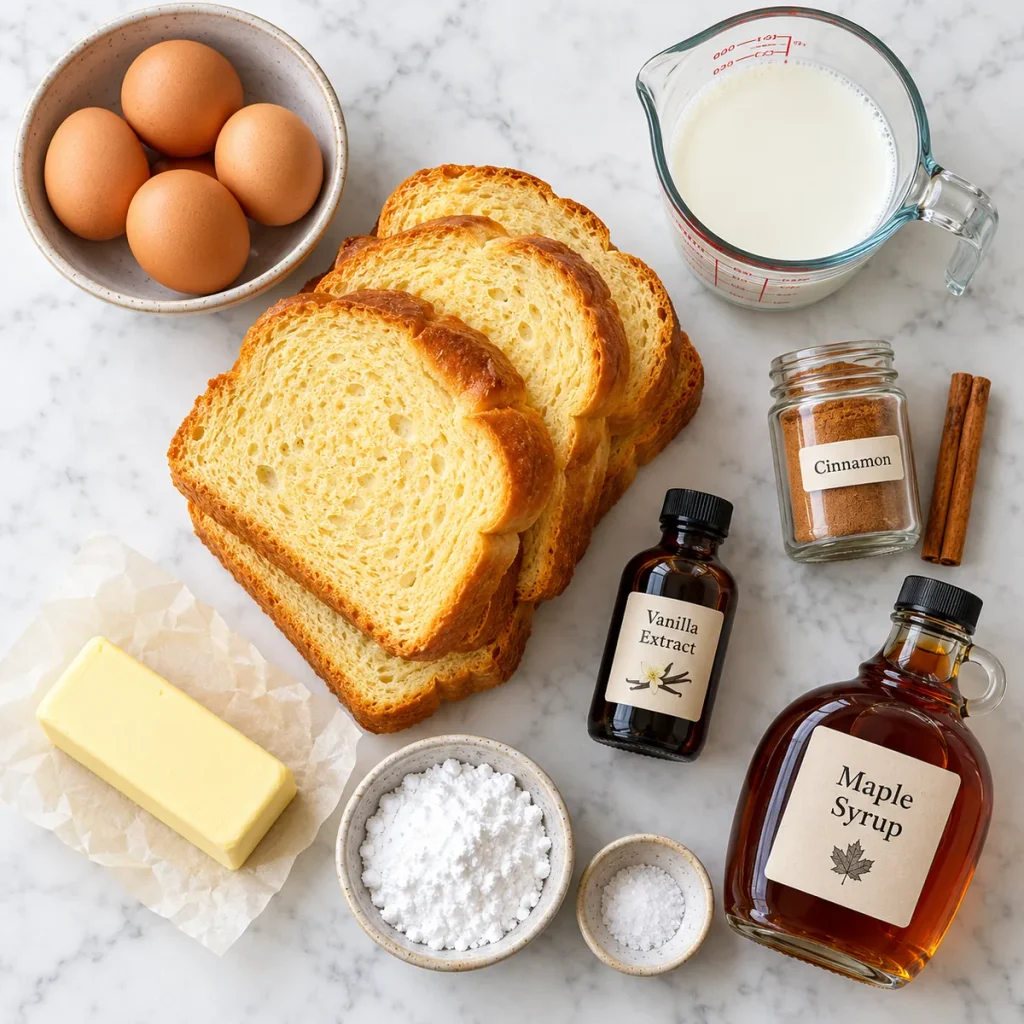
This french toast recipe uses two groups: the custard base and the cooking ingredients. Here is everything broken down.
Main Ingredients
- Brioche bread — 8 slices, ¾–1 inch thick. The foundation. Thick-cut bread is what separates a proper french toast recipe from a soggy breakfast disappointment.
- Eggs — 3 large. The protein that sets the custardy center when cooked. More eggs means more structure; fewer means more liquid and more soggy.
- Whole milk — ½ cup. Adds creaminess to the egg custard mixture. Whole milk gives the richest result; low-fat works but produces a lighter, less custardy center.
- Ground cinnamon — 1 teaspoon. Mixed into the custard so it flavors every bite, not just the surface. Don’t skip it — it’s what makes this taste like french toast and not scrambled eggs on bread.
- Vanilla extract — 1 teaspoon. Rounds out the sweetness and adds warmth to the custard. Pure vanilla extract is noticeably better than imitation here.
- Salt — a pinch. Balances the sweetness of the custard and makes the cinnamon flavor pop. One pinch — no more.
- Unsalted butter — 2 tablespoons. For cooking. Butter gives the golden brown crust its flavor — oil alone doesn’t work the same way.
Supporting Ingredients
- Powdered sugar — for serving. Dusted over the top just before serving — melts into the warm surface and adds a clean, light sweetness.
- Maple syrup — for serving. The standard topping. Real maple syrup — not pancake syrup — makes a noticeable difference in flavor. The difference in taste is significant enough that it’s worth the extra cost for this french toast recipe.
- Fresh berries — for serving (optional). Strawberries, blueberries, or raspberries cut through the richness of the custard and add color to the plate.
Optional Additions Table
| Add-In | Amount | Where to Add | Effect |
|---|---|---|---|
| Heavy cream | Replace ¼ cup milk | Custard | Richer, more luxurious center |
| Nutmeg | ¼ tsp | Custard | Classic warm spice note |
| Orange zest | 1 tsp | Custard | Bright, citrusy lift |
| Brown sugar | 1 tbsp | Custard | Caramel sweetness in every bite |
| Cream cheese filling | 2 tbsp per slice | Between two slices | Stuffed french toast version |
Complete Substitutions Reference
| Original | Substitution | Notes |
|---|---|---|
| Brioche bread | Challah or Texas toast | Both work well |
| Whole milk | Heavy cream | Richer; or use half-and-half |
| Whole milk | Oat milk or almond milk | Works; less custardy center |
| Vanilla extract | Almond extract (½ tsp) | Stronger — use less |
| Unsalted butter | Coconut oil | Works; different flavor |
| Eggs | No direct substitute | Eggs are essential for custard structure |
What NOT to Add
❌ Too much milk — over ¾ cup for 3 eggs makes the custard too thin and produces soggy french toast that won’t set in the pan
❌ Pre-ground stale cinnamon — old cinnamon that’s lost its aroma adds no flavor; check the jar smells sharp and spicy before using
❌ Sugar directly in the pan — sugar added to the pan burns before the bread cooks through; sweetness belongs in the custard only
❌ Cold butter in a cold pan — starting cold means uneven browning and butter that burns on the spots that heat first
❌ Thin sandwich bread — it goes completely soggy before the custard can set, and tears when you try to flip it
❌ Syrup poured while cooking — adding maple syrup mid-cook makes the pan sticky and burns the sugar coating onto the bread
Equipment You’ll Need
Choosing the Right Equipment
| Pan Type | Size | Best For |
|---|---|---|
| Cast iron skillet | 12-inch | Best heat retention, most even browning |
| Nonstick skillet | 12-inch | Easiest flip, good for beginners |
| Stainless steel pan | 12-inch | Works well; needs more butter |
| Griddle (stovetop) | Large | Best for batch cooking — fits 4+ slices |
| Electric griddle | Large | Most consistent heat for big batches |
Other Tools That Actually Matter
A shallow wide bowl or dish for the custard dip — deep bowls make it impossible to coat the bread evenly. A wide spatula with a thin edge is essential for flipping without tearing. A wire rack set over a baking sheet keeps finished slices warm in the oven without making the bottoms soggy. A kitchen timer is the most underrated tool for this french toast recipe — 2 minutes per side is the exact window, and it’s easy to lose track.
No Skillet? Alternatives That Work
- Electric griddle at 325°F — the most consistent heat for cooking 4–6 slices at once; set it and don’t adjust mid-cook
- Oven method (baked french toast) — dip slices in custard, arrange in a buttered 9×13 pan, bake at 400°F for 20–22 minutes; flips itself into a casserole style
- Air fryer — dip and place in a single layer at 370°F for 8–10 minutes; crispier exterior, works well for reheating leftover slices
How to Make French Toast — Step by Step
Eight steps. Most take under two minutes each.
Step 1 — Make the Custard (The Foundation of Everything)

Crack 3 large eggs into a wide, shallow bowl. Add ½ cup whole milk, 1 teaspoon ground cinnamon, 1 teaspoon vanilla extract, and a pinch of salt. Whisk vigorously for 45–60 seconds until fully combined and slightly frothy. The custard should look uniform — no streaks of egg white remaining. This french toast recipe step determines whether the finished french toast recipe tastes custardy and rich or flat and eggy. Under-whisked custard leaves pockets of unblended egg white that cook into rubbery spots in the finished slice.
💡 Pro Tip: Add a tablespoon of heavy cream to the custard if you want an extra-rich result — replace 2 tablespoons of the milk. The finished center is noticeably more set and silky.
Step 2 — Prepare the Bread (30 Seconds of Prep That Matters)
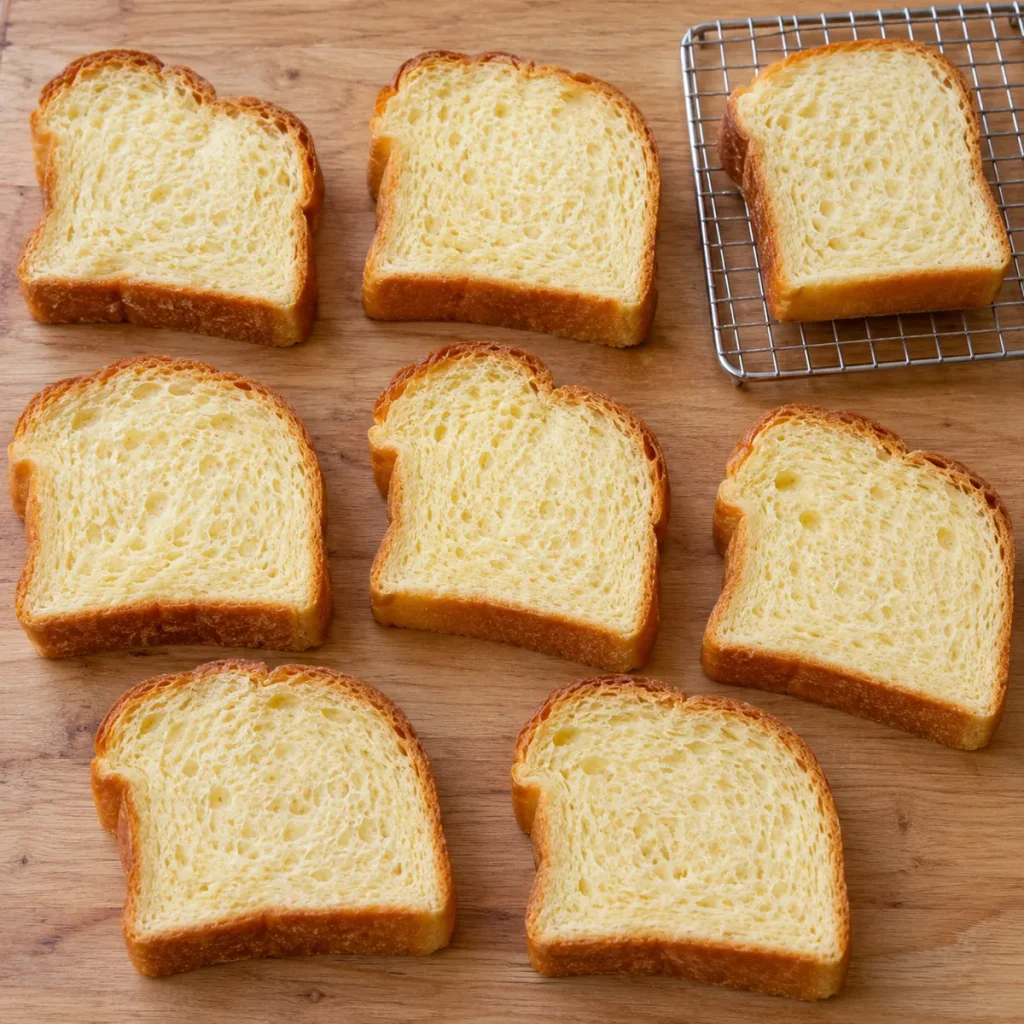
If your brioche is fresh from the bag, lay the slices on a wire rack for 10–15 minutes before dipping. Fresh, soft brioche absorbs custard too fast on the surface and not fast enough in the center — a brief air-dry creates a slightly firmer exterior that soaks evenly. Most recipes skip this, but Tested this 15+ times — the difference between a soggy exterior and a properly custardy center almost always comes down to whether the bread was slightly dried first or dipped straight from the bag.
💡 Pro Tip: If you’re using day-old bread, skip the drying step entirely — it’s already at the right moisture level for even absorption.
Step 3 — Dip the Bread (Don’t Rush It)
Dip each slice of brioche bread into the egg custard mixture and let it soak for exactly 20–30 seconds per side. Press gently so the custard reaches the center — you should see the slice absorb and slightly swell. Do not rush this french toast recipe step. The honest answer: under-soaked bread produces a dry, eggy exterior with a raw, floury center that no amount of butter in the pan can fix. Over-soaked bread falls apart before it hits the skillet. Twenty to thirty seconds per side is the exact window.
💡 Pro Tip: Hold the slice at an angle over the bowl after soaking and let excess custard drip off for 5 seconds — this prevents a puddle forming in the pan that steams the bread instead of frying it.
Step 4 — Heat the Pan (Temperature Is Everything)

Place your skillet over medium heat and let it warm for 90 seconds before adding any butter. Add 1 tablespoon of butter and watch it closely — it should foam immediately and the foam should start to settle within 15–20 seconds. That foam-settling moment is exactly when to add the bread. If the butter browns immediately and smells sharp, the pan is too hot — reduce heat and add a fresh tablespoon. Additionally, medium heat is the only setting that works for this french toast recipe — high heat burns the crust before the center sets, and low heat steams the bread instead of frying it.
💡 Pro Tip: Tilt the pan as the butter melts so it coats the entire surface evenly — this prevents dry patches where bread sticks and tears when you flip.
Step 5 — Cook the First Side (Patience Required)
Place 2–3 soaked slices into the pan without overlapping. Cook undisturbed for exactly 2 minutes. Do not press, do not peek underneath early, do not move the slices. Most importantly, resist the urge to lift the bread before the 2-minute mark — lifting too early tears the bottom crust before it has set enough to hold together.
more easy breakfast ideas from this site Egg Roll in a Bowl
When the 2 minutes are up, lift one corner with a spatula — the underside should be deep golden brown and the edge of the slice should look set, not wet. If it’s still pale, give it 30 more seconds. As a result, a properly cooked first side releases cleanly from the pan with no tearing or sticking.
💡 Pro Tip: Set a phone timer the moment the bread hits the pan — 2 minutes is shorter than it feels, and it’s easy to forget when you’re managing multiple slices.
Step 6 — Flip and Cook the Second Side
Slide a wide spatula fully under each slice and flip in one confident motion. The second side cooks faster than the first — 1 to 1.5 minutes is usually enough. The second side will always be slightly lighter in color than the first, which is normal. Cook until the second side feels firm when you press the center lightly — a slight spring-back means the egg custard mixture has fully set in the center.
💡 Pro Tip: Add a fresh half-tablespoon of butter to the pan before the second side goes down — the first tablespoon has mostly absorbed into the bread by now, and fresh butter gives the second side its own golden crust instead of cooking in a dry pan.
Step 7 — Keep Warm and Repeat

Transfer finished slices to a wire rack set over a baking sheet in a 200°F oven. Do not stack them and do not place them directly on a plate — stacking traps steam and makes the bottoms soft, and a plate with no airflow produces the same result. Add another tablespoon of butter to the pan and repeat the process with the next batch. The oven keeps finished slices perfectly warm and crisp for up to 20 minutes without any quality loss.
💡 Pro Tip: The wire rack method is the single biggest improvement most home cooks can make to their french toast recipe — it’s the same technique short-order diners use to keep toast orders crisp and warm during a busy service.
Step 8 — Plate and Serve


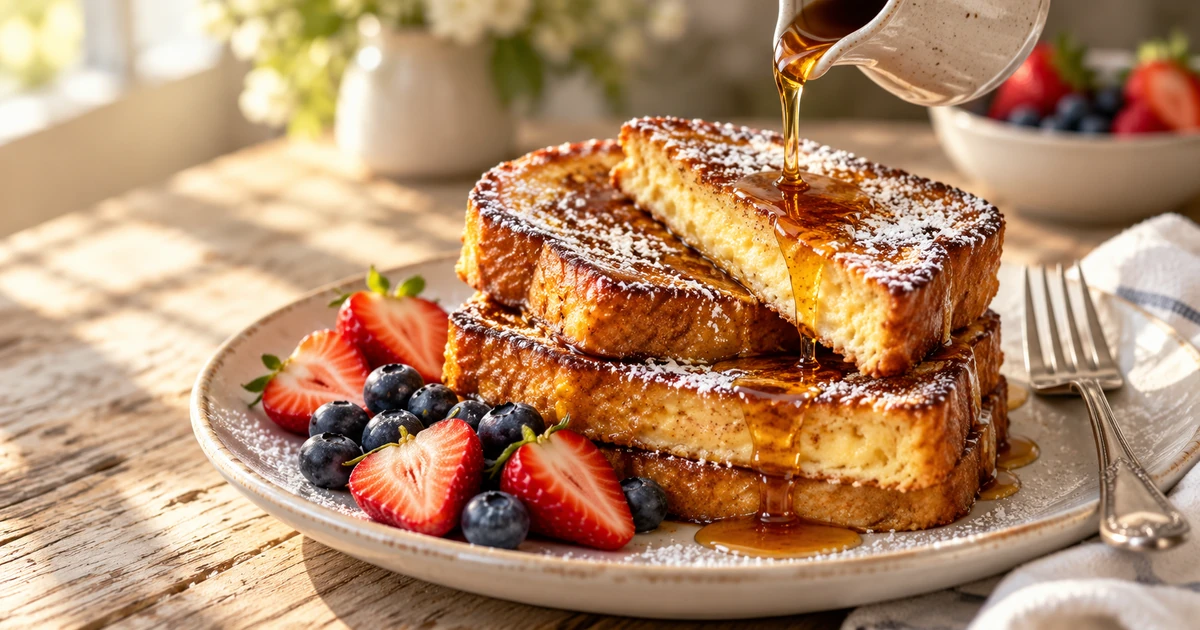
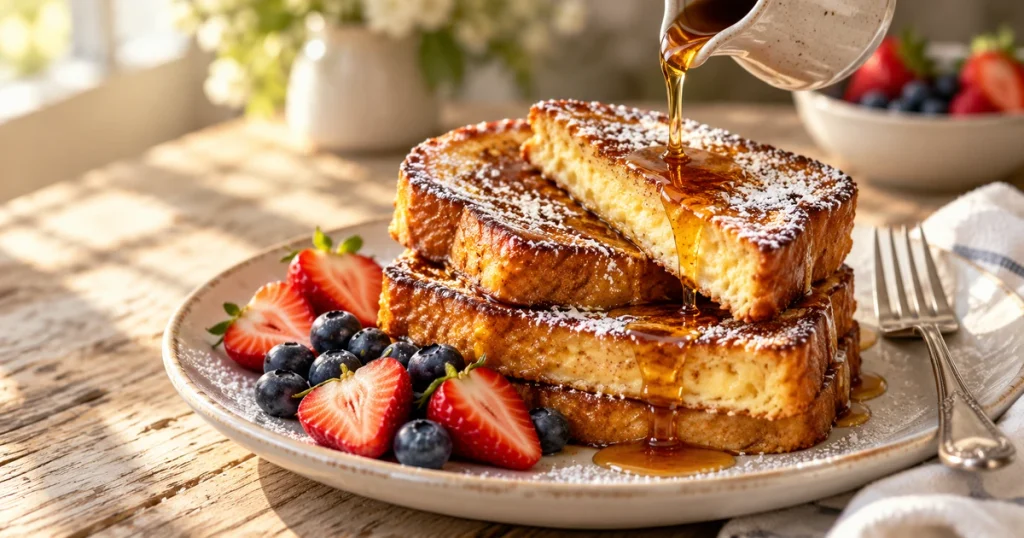
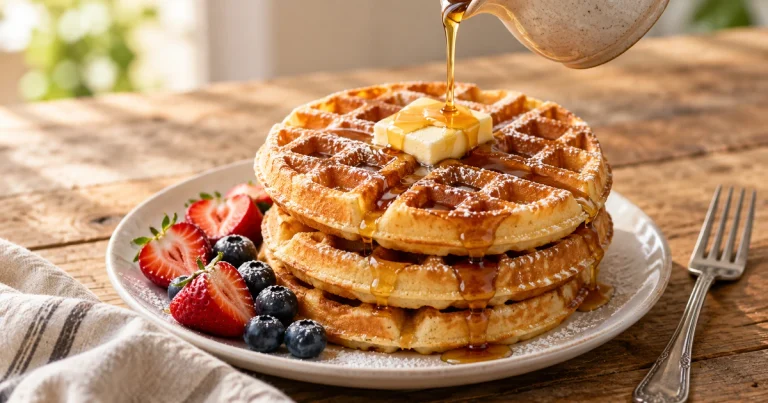
Stack 2–3 slices per plate, dust generously with powdered sugar, and pour maple syrup over the top. Add fresh berries on the side if using. Serve immediately while the golden brown crust is still crisp and the custardy interior is warm. French toast waits for no one — it’s best in the first 3 minutes after plating.
How to Tell When French Toast Is Done
In my kitchen, I’ve learned to trust the exact timing in this french toast recipe — but every stove runs a little differently, so start checking at 1 minute 45 seconds on your first attempt. Once you’ve made it once, you’ll know exactly where your stove lands.
Primary Doneness Test
Lift one corner of the slice with a spatula and look at the underside. French toast is done on the first side when the color is deep, even golden brown — not pale yellow, not dark brown. Pale yellow means underdone and the custard hasn’t set. Dark brown means the heat was too high and the exterior has overcooked before the center finished.
Doneness Guide
| Indicator | What It Means | What to Do |
|---|---|---|
| Pale yellow underside | Under-cooked | Cook 30–45 more seconds |
| Deep golden brown underside | Perfect | Flip immediately |
| Dark brown underside | Over-cooked first side | Reduce heat; second side will be fine |
| Center feels soft when pressed | Custard not fully set | Cook second side 30 more seconds |
| Center springs back when pressed | Custard set — done | Remove from pan |
| Edges still look wet | Not ready to flip | Wait 30 more seconds |
Visual Signs It’s Done
- The edges of the slice have changed from wet and glossy to set and matte
- The underside lifts cleanly without any tearing or sticking
- The color is uniform golden brown across the entire underside — no pale patches
- The top surface looks mostly dry — the raw custard sheen has disappeared
- A light press in the center springs back — it doesn’t feel soft or liquid underneath
It’s Not Right — What to Do Now
- Soggy center after cooking: Heat was too high — exterior cooked before center set; reduce to medium-low next batch and extend cook time by 30 seconds per side
- Too eggy in flavor: Custard wasn’t whisked enough — egg whites weren’t fully incorporated; whisk for a full 60 seconds next time
- Burned exterior, raw center: Pan was too hot; start at medium and test with a small piece of butter — it should foam but not brown in under 10 seconds
- Bread tore when flipping: Bread was too fresh and soft, or soaked too long; air-dry slices for 15 minutes and reduce soak time to 15 seconds per side
How to Make the Custard Dip

The custard dip is the entire foundation of this french toast recipe. The ratio, the ingredients, and how well it’s whisked all determine the final result. There are three versions depending on what you have available.
Method 1 — Standard Custard (Best Everyday Version)
3 eggs + ½ cup whole milk + 1 tsp cinnamon + 1 tsp vanilla + pinch of salt. Whisk for 60 seconds until frothy and fully uniform. This is the base french toast recipe and the one that works best for brioche bread. The ratio produces a fluffy french toast center that’s custardy but not heavy.
Method 2 — Rich Custard (Best Flavor Version)
3 eggs + ¼ cup whole milk + ¼ cup heavy cream + 1 tsp cinnamon + 1 tsp vanilla + 1 tbsp brown sugar + pinch of salt. The heavy cream replaces half the milk and the brown sugar adds a caramel note to the custard. This version is noticeably richer — closer to a crème brûlée texture in the center. It’s the version worth making when you want the french toast recipe to impress.
Method 3 — Dairy-Free Custard (Classic Method with Substitutes)
3 eggs + ½ cup full-fat oat milk or coconut milk + 1 tsp cinnamon + 1 tsp vanilla + pinch of salt. Oat milk is the closest dairy-free substitute in terms of creaminess and neutral flavor. Coconut milk adds a faint coconut note that pairs well with tropical toppings. However, the center will be slightly less custardy than the whole milk version — the protein and fat structure of dairy is hard to replicate exactly.
Troubleshooting Quick Reference
| Problem | Cause | Fix |
|---|---|---|
| Eggy flavor in finished toast | Under-whisked custard | Whisk 60+ seconds until fully frothy |
| Custard too thin, bread soggy | Too much milk | Reduce milk by 2 tbsp next batch |
| Cinnamon clumping in custard | Added cinnamon after eggs | Mix cinnamon with milk first, then add eggs |
| Custard pooling in pan | Bread not drained after soaking | Hold bread above bowl 5 seconds before placing in pan |
What to Serve With French Toast
Classic Pairings That Always Work
- Maple syrup — the non-negotiable standard; real maple syrup, not pancake syrup, makes a real difference at this quality level
- Fresh strawberries and blueberries — the acidity of berries cuts through the rich custard and makes every bite feel lighter
- Powdered sugar — dusted right before serving; melts into the warm surface and adds sweetness without heaviness
- Whipped cream — a generous spoonful on the side lets each person add as much or as little as they want
- Crispy bacon or breakfast sausage — the salty, savory contrast to sweet french toast is one of the best combinations in breakfast food
Comfort Food Pairings
- Scrambled eggs on the side — for anyone who wants a full protein-forward plate alongside the sweet toast
- Warm apple compote — cooked apples with cinnamon and butter poured over the top; a full autumn breakfast in one plate
- Peanut butter drizzle — melted peanut butter thinned with a little maple syrup, drizzled over the stack; adds richness and protein
- Caramelized bananas — cook sliced bananas in butter and brown sugar for 3 minutes and spoon over the top; turns this into a full brunch showpiece
- Nutella and crushed hazelnuts — a European-style finish for when the standard toppings feel too ordinary
Low-Carb Options
- Keto french toast with almond flour bread — same technique, same custard, different bread; the result is slightly denser but the flavor holds
- Greek yogurt instead of whipped cream — adds protein and tang; pairs especially well with fresh berries on top
- Berries with no syrup — the natural sweetness of ripe strawberries and blueberries is enough when the custard is properly seasoned
6 Ways to Use Leftover French Toast

Leftover french toast may actually be better than the original. Here are 6 meals that prove it.
French Toast Sticks
What you need: Leftover french toast slices, maple syrup for dipping.
How to assemble: Cut each slice into 3–4 long strips. Reheat in an air fryer at 370°F for 4–5 minutes until the exterior crisps back up. Serve standing upright in a cup with maple syrup for dipping.
One tip: French toast sticks reheated in an air fryer are crispier than the original — the circulating heat restores the golden brown crust better than any other reheating method.
French Toast Casserole
What you need: 4–6 leftover slices, 2 eggs, ¼ cup milk, cinnamon, butter, brown sugar.
How to assemble: Cut leftover french toast into cubes. Whisk eggs, milk, and cinnamon together. Toss the cubes in the mixture and pour into a buttered 8×8 pan. Top with brown sugar and bake at 375°F for 20–22 minutes until set and golden.
One tip: This casserole is the best version of french toast to make for a crowd — it serves 6 and requires almost no active cooking time.
French Toast Ice Cream Sandwich
What you need: 2 leftover slices, 1 scoop vanilla ice cream, cinnamon.
How to assemble: Freeze leftover slices for 20 minutes. Scoop ice cream onto one slice and press the second on top. Dust with cinnamon and serve immediately or return to freezer for 30 minutes for a firmer sandwich.
One tip: The custard flavor of the french toast pairs unexpectedly well with salted caramel ice cream — better than vanilla by most measures.
French Toast Bread Pudding
What you need: All leftover french toast, 1 cup milk, 2 eggs, vanilla, brown sugar, butter.
How to assemble: Tear leftover french toast into rough chunks and place in a buttered 9×9 baking dish. Whisk milk, eggs, vanilla, and brown sugar together and pour over the chunks. Press gently and let soak 10 minutes. Bake at 350°F for 30–35 minutes until set and golden on top.
try another easy weekend recipe here Sweet Potato Casserole if you enjoyed french toast recipe.
One tip: Bread pudding made from leftover french toast is noticeably richer than one made from plain bread — the custard already baked into the slices gives it a double-custard depth.
French Toast Parfait
What you need: Crumbled leftover french toast recipe, vanilla yogurt, fresh berries, honey.
How to assemble: Layer crumbled french toast at the bottom of a glass, then yogurt, then fresh berries, then a drizzle of honey. Repeat once and top with a light dusting of cinnamon.
One tip: Build this parfait right before eating — crumbled french toast absorbs moisture from the yogurt within 10–15 minutes and loses its texture if it sits too long.
French Toast Breakfast Sandwich
What you need: 2 leftover slices, 2 eggs, cheese, salt and pepper.
How to assemble: Reheat two slices in a pan over medium heat. Fry or scramble eggs separately with salt and pepper. Layer eggs and a slice of cheese between the two french toast slices. Press gently and cook in the pan for 30 seconds per side to melt the cheese.
One tip: A thin spread of cream cheese on the inside of each slice before adding the eggs makes this sandwich taste like a restaurant dish — the cream cheese melts into the warm custard bread and adds a layer the egg alone can’t provide.
Storage, Freezing and Reheating Guide
Refrigerator Storage (Up to 3 Days)
Let this french toast recipe cool to room temperature before storing — placing warm slices in a container traps steam and makes them soggy. Store in an airtight container or zip-lock bag with parchment paper between each slice for up to 3 days. The custard interior stays intact in the refrigerator; only the crust softens, which reheating restores.
Can You Make This Ahead of Time?
Yes — two ways. Make the custard mixture up to 24 hours ahead and refrigerate in a covered container; whisk once more before using. Or cook the full batch of french toast, cool completely, and refrigerate for up to 3 days — reheat as needed. However, the best make-ahead method for a crowd is the overnight french toast casserole: arrange uncooked soaked slices in a baking dish, cover, refrigerate overnight, and bake at 375°F for 30–35 minutes in the morning.
Freezer Storage (Up to 1 Month)
This french toast recipe freezes well for up to 1 month. Lay cooled slices in a single layer on a baking sheet and freeze for 1 hour until solid, then transfer to a freezer bag with parchment between slices. Reheat directly from frozen — no thawing needed. The texture after freezing is slightly firmer than fresh, but the flavor is intact.
This Works as a Freezer Meal
This french toast recipe works perfectly as a freezer meal. Make a double or triple batch specifically for the freezer. Freeze individual portions in labeled bags. On busy weekday mornings, pull 2 slices from the freezer and reheat in the toaster or air fryer — faster than any drive-through quick breakfast recipe and significantly better in quality.
How to Reheat Without Ruining It
| Method | Setting | Time | Notes |
|---|---|---|---|
| Air fryer | 370°F | 4–5 min | Best method; restores crisp crust |
| Toaster | Medium-high | 1–2 cycles | Quick and effective for single slices |
| Skillet | Medium | 1–2 min per side | Good; add a small knob of butter |
| Oven | 350°F | 8–10 min | Good for batches; use wire rack |
| Microwave | 70% power | 30–45 sec | Fast but softens the crust |
Weekly Meal Prep Strategy
Make a full batch every Sunday. Cool and freeze in individual portions. Pull slices each morning and reheat in the toaster or air fryer — the entire reheating process takes under 5 minutes.
Lasagna Soup see more make-ahead meal ideas here
This is one of the most practical weekend breakfast recipes to batch-cook because it reheats better than almost any other egg-based dish.
Recipe Variations Worth Trying
Same technique. Completely different flavor profiles. Master the base french toast recipe first — then try one of these.
Most Popular — Stuffed French Toast
Use the same custard recipe. After soaking, place one slice flat in the pan. Spread 2 tablespoons of cream cheese mixed with 1 tablespoon of powdered sugar on top. Place a second soaked slice on top like a sandwich and press gently. Cook 2.5–3 minutes per side at medium-low — the extra thickness needs more time. The cream cheese melts into the center and creates a rich, cheesecake-like filling between the layers of fluffy french toast.
International — Torrijas (Spanish French Toast)
Soak thick slices of day-old white bread in warm sweetened milk for 10 minutes, then dip in beaten egg and fry in olive oil instead of butter. Dust with cinnamon sugar immediately after cooking. This is the original version of the french toast recipe from Spanish tradition — made during Easter and Holy Week. The olive oil gives it a crispier, more savory exterior that contrasts beautifully with the cinnamon sugar finish.
Low-Carb — Almond Flour French Toast
Use thick-cut almond flour bread (homemade or store-bought). Keep the custard exactly the same — the egg and milk ratio doesn’t change. Cook at medium heat for 2.5 minutes per side — almond flour bread is more delicate and needs slightly lower heat. Therefore, anyone following a low-carb diet gets the full french toast experience without any flour adjustments to the custard itself.
Quick Weeknight Shortcut — Mug French Toast
One slice of bread, one egg, 2 tablespoons milk, pinch of cinnamon and vanilla — all mixed in a large mug. Press the bread into the mug and microwave on high for 60–90 seconds. Top with maple syrup and serve in the mug. Total time: under 3 minutes. It’s not the same as pan-fried french toast, but it genuinely works as a single-serving quick breakfast recipe when nothing else is available.
Fresh and Elevated — Crème Brûlée French Toast
Use the rich custard (Method 2 above) with heavy cream. After cooking, dust the top of each slice with 1 teaspoon of granulated sugar. Use a kitchen torch to caramelize the sugar into a thin, crackly crust. The result is a french toast recipe that looks and tastes like a restaurant dessert — the caramelized sugar shell cracks when you press a fork through it and the custardy interior underneath is completely soft. Serve with fresh raspberries and no syrup needed.
Nutrition Information
Per Serving Breakdown (Based on 4 Servings / 2 Slices Each)
| Nutrient | Amount | % Daily Value |
|---|---|---|
| Calories | ~320 | — |
| Total Fat | 13g | 17% |
| Saturated Fat | 6g | 30% |
| Cholesterol | 175mg | 58% |
| Sodium | 340mg | 15% |
| Total Carbohydrates | 38g | 14% |
| Dietary Fiber | 1g | 4% |
| Total Sugars | 9g | — |
| Protein | 12g | 24% |
| Calcium | 95mg | 7% |
Note: Nutrition calculated without toppings. Add ~52 calories per tablespoon of maple syrup.
Dietary Compatibility
| Diet | Compatible | Notes |
|---|---|---|
| Gluten-Free | ❌ | Use certified GF bread to adapt |
| Dairy-Free | ✅ | Use oat milk or coconut milk instead |
| Paleo | ❌ | Bread and dairy excluded from strict Paleo |
| Keto | ❌ | See almond flour variation above |
| Vegetarian | ✅ | No meat in this french toast recipe |
| Vegan | ❌ | Eggs are essential; no direct substitute maintains texture |
To reduce calories per serving, use low-fat milk instead of whole milk and reduce butter to 1 tablespoon total for the full batch — the crust will be slightly less golden but still acceptable.
8 Mistakes That Ruin French Toast
Every one of these mistakes is fixable. Know them before you start — not after.
❌ Mistake 1: Using Thin Sandwich Bread
Why it happens: It’s what’s in the house. What goes wrong: Thin bread is saturated before it reaches the pan — it goes completely soggy, tears on contact with the spatula, and steams instead of fries. The fix: Use brioche, challah, or Texas toast at ¾ to 1 inch thick. This single change improves the result more than any other adjustment.
❌ Mistake 2: Pan Temperature Too High
Why it happens: Wanting faster results. What goes wrong: The exterior burns before the egg custard mixture in the center has time to set — you get a dark, bitter crust with a raw, eggy interior. The fix: Medium heat only. Test with a small piece of butter — it should foam without browning in under 15 seconds.
❌ Mistake 3: Not Whisking the Custard Enough
Why it happens: Rushing the prep. What goes wrong: Unblended egg whites cook into rubbery white streaks on the surface of the finished slice. The fix: Whisk for a full 60 seconds until the custard is frothy and completely uniform — no visible egg white streaks remaining.
❌ Mistake 4: Too Much Milk in the Custard
Why it happens: Trying to stretch the custard to cover more slices. What goes wrong: A watery custard doesn’t set during cooking — the french toast stays soggy no matter how long it stays in the pan. The fix: Stick to the 3 eggs to ½ cup milk ratio for 8 slices. If you need more custard, scale the full recipe rather than adding extra milk alone.
❌ Mistake 5: Soaking the Bread Too Long
Why it happens: Thinking more soak equals more flavor. What goes wrong: Over-soaked brioche falls apart before it reaches the pan, and the excess custard pools and burns in the bottom of the skillet. The fix: 20–30 seconds per side is the exact window. Drain briefly by holding the slice over the bowl after soaking.
❌ Mistake 6: Flipping Too Early
Why it happens: Impatience or fear of burning. What goes wrong: The bottom crust hasn’t set enough to hold together when the spatula gets under it — the slice tears and the interior custard spills out. The fix: Set a timer for 2 minutes and do not lift, peek, or move the slice before it goes off.
❌ Mistake 7: Stacking Finished Slices on a Plate
Why it happens: The instinct to plate everything together and serve. What goes wrong: Steam from the hot slices softens every crust in the stack within 2 minutes — by the time the last batch is cooked, the first batch is limp and soft. The fix: Wire rack over a baking sheet in a 200°F oven. This is the method — there is no substitute.
❌ Mistake 8: Using Cold Eggs Straight From the Fridge
Why it happens: Not thinking about ingredient temperature. What goes wrong: Cold eggs lower the temperature of the custard and slow how quickly it sets in the pan — the result is a longer cook time that dries out the bread exterior before the center finishes. The fix: Pull eggs from the refrigerator 15 minutes before making the custard, or set them in a bowl of warm (not hot) water for 5 minutes.
Frequently Asked Questions
What is the best bread for This French toast recipe?
Brioche is the best bread for this french toast recipe — it’s enriched with butter and eggs in the dough, which means it absorbs the custard without falling apart and develops a golden brown crust in the pan that plain bread can’t match. Challah is the best substitute when brioche isn’t available. Texas toast works well for a budget-friendly version. The one bread to avoid completely is thin sandwich bread — it saturates before it hits the pan and tears when you try to flip it.
How do you make French toast not soggy?
Three things cause soggy french toast: too much milk in the custard, soaking the bread too long, and cooking at too low a temperature. The honest answer: the fix for all three is in this french toast recipe. Use 3 eggs to ½ cup milk (not more), soak each slice for 20–30 seconds per side (not longer), and cook at medium heat in a preheated pan with foaming butter. Additionally, never stack finished slices — use a wire rack in a low oven to keep them crisp while you finish the batch.
What is the ratio of eggs to milk for French toast?
The correct ratio for this french toast recipe is 3 large eggs to ½ cup whole milk for 8 slices of thick-cut bread. This ratio produces a custard thick enough to set during cooking rather than steam. More milk than this makes the custard too thin — the bread absorbs more liquid than the eggs can bind and the center never firms up properly. Fewer eggs than this and the flavor tips too far toward plain milk-soaked bread.
Should you use milk or heavy cream for French toast?
Whole milk is the standard for everyday This french toast recipe and produces an excellent result. Heavy cream produces a richer, more custardy center that’s noticeably more luxurious — use it when you want the french toast recipe to impress. The best approach is to use half milk and half heavy cream: ¼ cup of each for a 3-egg custard. This gives you most of the richness of cream without the heavy caloric load of using cream alone.
How long do you cook French toast on each side?
This french toast recipe cooks for exactly 2 minutes on the first side and 1 to 1.5 minutes on the second side at medium heat. The second side always cooks faster because the pan is already fully hot and the custard on that side is partially set from the heat that transferred through the first side. Set a timer — it’s easy to over or under-cook by feel alone, and the difference between 90 seconds and 2 minutes is the difference between a pale underdone crust and a proper golden brown one.
Can you make French toast ahead of time?
Yes — this french toast recipe can be made ahead completely. Cook the full batch, cool completely, and refrigerate for up to 3 days or freeze for up to 1 month. Reheat in an air fryer at 370°F for 4–5 minutes to restore the crisp crust, or in a toaster on medium-high. The make-ahead version reheats surprisingly well — better than most people expect from an egg-based breakfast. For a full crowd, the overnight casserole method (soaked slices baked together) is even better for advance preparation.
What do you serve with French toast?
When serving this french toast recipe, maple syrup and fresh berries are the classic combination and the one that works best. Powdered sugar dusted over the top adds sweetness without weight. For a full breakfast, crispy bacon or sausage alongside provides the savory contrast that makes the sweet toast taste better by comparison. Whipped cream on the side lets people add their own — a tablespoon on top of a warm slice melts slightly and mimics the richness of the custard underneath.
Can you freeze French toast?
Yes — this french toast recipe freezes well for up to 1 month. Let slices cool completely, then freeze flat on a baking sheet for 1 hour before bagging. Place parchment paper between slices in the freezer bag so they don’t stick together. Reheat directly from frozen in an air fryer or toaster — no thawing required. Tested this 15+ times — the texture after air fryer reheating from frozen is nearly identical to fresh, which makes this french toast recipe one of the best breakfast items to batch-freeze.
Why does my French toast taste eggy?
The most common reason this french toast recipe tastes eggy is under-whisked custard — egg whites that weren’t fully incorporated into the milk cook into rubbery, eggy patches on the surface of the slice. Whisk the custard for a full 60 seconds until completely frothy and uniform. The second cause is too high an egg-to-milk ratio — if you added extra eggs without adding more milk, the custard is too protein-heavy. The third cause is cooking at too low a temperature, which steams the custard instead of frying it and amplifies the egg flavor.
How do you make French toast without vanilla extract?
The vanilla in this french toast recipe adds warmth and rounds out the sweetness — without it, the custard tastes a little flat. The best substitutes in equal amounts are almond extract (use ½ teaspoon — it’s stronger), maple extract (1 teaspoon — adds a syrup note), or cinnamon extract (½ teaspoon). If you have none of these, add an extra pinch of cinnamon and a teaspoon of maple syrup directly to the custard — together they approximate what vanilla brings to the overall flavor.
Is this french toast recipe good for meal prep?
Yes — this french toast recipe is one of the best breakfast options for weekly meal prep. Cook a full batch on Sunday, cool completely, and refrigerate or freeze in individual portions. Each serving reheats in under 5 minutes in an air fryer or toaster. The custard interior stays intact and the golden brown crust comes back with dry heat reheating.
Can you make this french toast recipe for a crowd?
Yes — this french toast recipe scales easily for a crowd. Double or triple the custard ratio exactly and cook in batches on a large griddle. Keep finished slices warm on a wire rack in a 200°F oven for up to 20 minutes without any loss in quality. For the easiest crowd version, use the overnight casserole method — soak slices the night before and bake at 375°F for 30–35 minutes in the morning.
You Might Also Like
Classic Pancakes from Scratch
Red Velvet Cake check out this french toast recipe next
Recipe Card

FRENCH TOAST RECIPE
Ingredients
Equipment
Method
- Whisk eggs, milk, cinnamon, vanilla, and salt in a wide shallow bowl for 60 seconds until frothy and fully combined.
- Lay brioche slices on a wire rack for 10–15 minutes to air-dry slightly if fresh from the bag.
- Dip each slice in custard for 20–30 seconds per side. Hold over bowl for 5 seconds to drain excess.
- Heat skillet over medium heat for 90 seconds. Add 1 tablespoon butter — it should foam immediately.
- Place 2–3 slices in the pan. Cook undisturbed for exactly 2 minutes.
- Flip. Add a small knob of fresh butter. Cook second side 1–1.5 minutes until golden.
- Transfer to a wire rack over a baking sheet in a 200°F oven. Repeat with remaining slices.
- Plate 2–3 slices per serving. Dust with powdered sugar, pour maple syrup, add fresh berries. Serve immediately.
Notes
⚠️ Never cook on high heat — the exterior burns before the custard center has time to set.
✅ Air-dry fresh brioche for 10–15 minutes before dipping — prevents a soggy exterior.
🔄 No brioche? Use challah or Texas toast at the same thickness.
❄️ Refrigerate up to 3 days or freeze up to 1 month. Reheat in air fryer at 370°F for 4–5 minutes.
📌 The wire rack method in a 200°F oven keeps every slice crisp while you finish the batch — never stack on a plate. Make Ahead + Freezer Notes
Cook full batch, cool completely, freeze flat then bag with parchment between slices. Reheat from frozen in air fryer or toaster — no thawing needed.
🍽 FRENCH TOAST RECIPE
⭐⭐⭐⭐⭐ [Star rating widget placeholder]
Thick, custardy french toast with a golden brown crust — ready in 15 minutes with 6 simple ingredients.
| Prep | 5 min |
| Cook | 10 min |
| Total | 15 min |
| Servings | 4 (2 slices each) |
| Calories | ~320 per serving |
Equipment
- 12-inch skillet (cast iron or nonstick)
- Wide shallow bowl for custard
- Wide spatula
- Wire rack + baking sheet
- Kitchen timer
Ingredients
Custard:
- 3 large eggs, room temperature
- ½ cup whole milk, room temperature
- 1 tsp ground cinnamon
- 1 tsp vanilla extract
- Pinch of salt
For Cooking:
- 8 slices brioche bread, ¾–1 inch thick
- 2 tbsp unsalted butter
For Serving:
- Powdered sugar
- Maple syrup
- Fresh berries (optional)
Instructions
- Whisk eggs, milk, cinnamon, vanilla, and salt in a wide shallow bowl for 60 seconds until frothy and fully combined.
- Lay brioche slices on a wire rack for 10–15 minutes to air-dry slightly if fresh from the bag.
- Dip each slice in custard for 20–30 seconds per side. Hold over bowl for 5 seconds to drain excess.
- Heat skillet over medium heat for 90 seconds. Add 1 tablespoon butter — it should foam immediately.
- Place 2–3 slices in the pan. Cook undisturbed for exactly 2 minutes.
- Flip. Add a small knob of fresh butter. Cook second side 1–1.5 minutes until golden.
- Transfer to a wire rack over a baking sheet in a 200°F oven. Repeat with remaining slices.
- Plate 2–3 slices per serving. Dust with powdered sugar, pour maple syrup, add fresh berries. Serve immediately.
Recipe Notes
⚠️ Never cook on high heat — the exterior burns before the custard center has time to set.
✅ Air-dry fresh brioche for 10–15 minutes before dipping — prevents a soggy exterior.
🔄 No brioche? Use challah or Texas toast at the same thickness.
❄️ Refrigerate up to 3 days or freeze up to 1 month. Reheat in air fryer at 370°F for 4–5 minutes.
📌 The wire rack method in a 200°F oven keeps every slice crisp while you finish the batch — never stack on a plate.
Make Ahead + Freezer Notes
Cook full batch, cool completely, freeze flat then bag with parchment between slices. Reheat from frozen in air fryer or toaster — no thawing needed.
Nutrition Per Serving
Calories: ~320 | Protein: 12g | Fat: 13g | Carbs: 38g | Fiber: 1g | Sodium: ~340mg
Dietary Info
❌ Gluten-Free | ✅ Dairy-Free (with oat milk) | ❌ Paleo | ❌ Keto | ✅ Vegetarian | ❌ Vegan
Did You Make This?
Tag @DavidRecipes and leave a ⭐⭐⭐⭐⭐ rating below.
— David | DavidRecipes
David is a home cook who has spent years developing straightforward, no-fuss recipes that work for real weeknight kitchens. Every recipe on DavidRecipes is made, tested, and eaten before it ever gets published — usually multiple times.



7 Comments